
• Skip to main content
wb-financial-logo
  • About
  • Services
  • Team
  • News
  • Contact
  • Client Portal
×
  • About
  • Services
  • Team
  • News
  • Contact
  • Client Portal
07 3391 7199

despina

Economic Update – March 2021

despina · Mar 9, 2021 ·

Bond yields spike
– US inflation fears bubble up and the 10-year bond interest rate rises to reflect this

– Globally, COVID 19 cases have declined for 6 weeks; millions vaccinated in the US and UK

– Corporate earnings strongly surprise on the upside; and governments continue spending


The Big Picture

As if there wasn’t enough to contend with in coping with the pandemic — US 10-year bond yields spiked at the end of February and that sent Wall Street into a tail-spin. The two phenomena are connected, though not in an obvious way.

President Biden and his team are making great inroads into vaccinating all US adults who want the vaccine sooner than many expected. That was the bad news! Such was the glee at starting to put an end to the pandemic (or so many think – but more of that later), investors and analysts started to think about a rapid recovery for the US economy.

If/when the US economy fully recovers, that will/might bring with it, inflation – a problem that the US has not struggled with for more than a decade. Significant inflation means that the US Federal Reserve (“The Fed”) will have to start raising its federal funds rates from almost zero, up to something a bit more in line with historical norms.

With participants suddenly confronted with the possibility of tighter monetary policy, the yields on longer-dated US Treasuries started to rise – and quickly. The next piece in the jigsaw is that 10-year yields are just about up to dividend yields on the S&P 500. At long last there seemed to be some alternative to investing in shares! While this sequence of events seems logical, we think the argument is flawed. And the Fed chairman, Jay Powell, agrees.

Markets react harshly when they are blind-sided. The S&P 500 fell 2.5% on the last Thursday of February, and then fell a further 0.5% the next day. Ouch! For the US to achieve “herd immunity” where the virus dies out on its own, it is widely accepted that the US needs to vaccinate around 70% or more with an “efficacious” vaccine like the ones from Pfizer and Moderna.

Biden has assured us that he will have 600 million doses available by the end of July, though that’s a long way away from getting two jabs into well-over 200 million American arms. There are two major problems that Biden is not yet addressing.

First, there is a lot of push-back in the US to being vaccinated. Whatever their reasons, it is not likely that the US can get enough people vaccinated quickly enough; especially as two jabs are required. How do you find the person for the second jab and how do you record a successful pair of vaccinations – on a digital passport?
Tracking may well offend some US citizens as they might see it as another case of Big Brother. Tracking is, however, working well in Australia for finding sources of COVID infection.

The second problem is even bigger. People who have been vaccinated can still get infected and pass it on, but they won’t get sick themselves. Masks and social distancing aren’t going away any time soon. Coupled with this problem is the fact that the rest of the world is not moving at the same rate. We only just started our vaccinations in the last week of February while the US had reportedly already vaccinated over 60 million people. And what about poorer nations?

For the US economy to boom again it also needs people and goods crossing its international borders. And what about Mexico? How many new illegal immigrants will have been vaccinated. How many illegal immigrants in the US will come forward for a jab? And then we have the problems about new strains emerging. If there are pockets of people scattered around the world being exposed to COVID; new, more virulent strains such as the United Kingdom and South African variants, and worse, may be created. We applaud the work the US is doing in trying to eradicate the virus. We just think it will take a lot longer before they are back to ‘normal’.

We did not see all of Jay Powell’s testimony to the two chambers of Congress, but we did see his conclusion. Paraphrased, he said that it will be at least three years before we can reach the inflation target; and he thinks it will be a similar length of time before they achieve full employment.

So, if the inflation scare was a false dawn, what might we expect about bonds and share dividends? The US 10-year yield was around 1.8% to 1.9% in the weeks around the start of 2020 – before most of us knew anything about COVID. This yield fell to around 0.6% to 0.7% in the middle of 2020 and started to rise gently from when the vaccines were announced in November 2020, to about 1.0% to 1.1% in mid-February.

That was a massive fall in yields to 0.5% and a massive rise to 1.1% on the way back. But the even-more massive rise to a short-lived 1.614% near the end of February is what spooked the markets.

We think some people extrapolated the recent short, sharp, rise in yield without context. If the yield gets back 1.9%, that is still only where it was positioned before the pandemic. Why should it continue to rise above that without a new big impetus? If, as we suggested, the economy will only glide back to pre-COVID strength, why should it have even reached 1.6%? We think it was an over-reaction. It fell to 1.41% in just over 24 hours!

With bond yields getting back to near-dividend yields on shares, we should also ask the question of why dividend yields fell so low. Historically, yield on the S&P 500 was around 2.5% — a full 1% point above where they are now.

Earnings fell in 2020 (from where dividends are paid) and companies became more risk-averse as they found it hard to predict where the economy was going. So, they retained a bigger share of earnings than normal.

Reporting season for quarter 4 (Q4) in the US was very strong and, on average, beat earnings estimates. Earnings are predicted to rise from here so we expect dividend yields to start to rise. That means bonds are not a great alternative to shares going forward – at least for a year or two.

As we have highlighted previously, we expected any number of shocks to equity markets as news about the pandemic emerged. This recent sell off in the bond market was just one of them. There will be more. These events are disconcerting for investors and while we don’t know the exact outcome in the short term, we do know having a well-founded long-term investment strategy is the prudent approach to look through bouts of volatility.

Turning to Australia, our situation is quite different from that in the US. They vaccinated over 60 million people in the US before Scott Morrison got his jab at the head of the queue.

We only have enough efficacious Pfizer vaccine for less than 10 million people in Australia and no Moderna, a similar and equally efficacious vaccine. We were not able to secure more of these two vaccines used in the US so we are left with 53.8 million doses of AstraZeneca’s (AZ) vaccine.

Importantly, the US has not yet approved AZ for the US and South Africa has suspended the use of AZ. A dozen or more European countries are not recommending and/or allowing over 65s to be given AZ. The reason is that there is great debate about its efficacy (or usefulness). Nobody is suggesting it will harm anyone; it’s just much less useful than the Pfizer/Moderna formulations. Indeed, many say that AZ is not strong enough to produce herd immunity – the end game.

We clearly need a Plan B but approval has not yet even been given for the 50 of the 53.8 million doses of AZ being manufactured in Melbourne by CSL. We have 51 million doses of Novavax on order but that is not only yet to be approved; there is very little known about the trial results.

Australians and the authorities have done a spectacular job in containing COVID. However, without an efficacious vaccine, it may well be 2022 before we start to tackle the underlying problem. Not only will Americans have to continue with masks and social distancing, etc., we will have to be even more vigilant and for longer.

Our labour market is, however, continuing to improve. The latest unemployment rate fell from 6.6% to 6.4% and over 29,000 now jobs were created. Our Westpac and NAB confidence and conditions surveys are still pointing to a mildly optimistic sentiment across consumers and businesses. However, our retail sales only grew by 0.6% for the month, when 2.0% had been expected.

Our government and central bank, Reserve Bank of Australia (RBA), continue to work hard at keeping the economy together. The RBA just extended its Quantitative Easing (QE) programme by $100bn from mid-April at $5bn per week buying long-dated bonds that they estimate keeps the bond yield down by about 30 basis points (bps) or 0.3 percentage points.

In conclusion, we believe that the US and Australia are doing enough to promote economic growth or at least keep it above what it would have otherwise been. The US Congress is close to putting another $1.9 trillion into the system in the form of cash payments, top-up benefits and COVID needs. Much of that expenditure just perpetuates what was already passed but would have run out by March 14th without it.

We do not feel the need to alter our investment strategy for the year ahead at this point; however, we must expect more speed bumps along the way.


Asset Classes

Australian Equities 
The month of February was good for the ASX 200 in that the harsh sell off on the last day still left the index up by 1.0% for the month. The Energy sector (+2.1%) had a good month but Financials (+4.5%) and Materials (+7.2%) were spectacular; Utilities ( 8.8%) was the main laggard.

The last few months have been difficult for investors as the ‘style’ of stocks (growth, value, cyclicals, defensives, etc.) in favour have switched back and forth, largely on news about the pandemic.

The second half of 2020 reporting season is all but over. The results were not only largely very strong relative to forecasts but historical estimates of earnings were revised upwards as actuals were published.

International Equities 

The S&P 500 (+2.5%) gained strongly in February despite losing  3.0% in the last two days of the month. Most other major indexes also did well. US fourth quarter reported earnings were also strong but there have been some major moves in certain sectors. Technology had been the poster child of the index for some time. It is always hard to value high growth stocks and some tech stocks were sold off quite heavily during the month. That means the tech-based Nasdaq underperformed the Dow and the S&P 500 for the first time in a while.

Bonds and Interest Rates

We discussed the bond yield spike in some detail in the overview – such is the importance of the topic. Suffice it to say here that the short duration end of the US yield curve has been well anchored out to about two years’ duration. The yield curve has been steepening quite sharply (yields on long durations securities e.g., 10-year bonds rising faster than short duration instruments such as cash) since around the time of the presidential election in November 2020 and the announcements of vaccines being approved.

The Australian 10-yr bond stands at 1.9% or a full 50 bps above the US yield. The RBA has about six months of Quantitative Easing (QE) ready to help keep yields on longer dated government bonds in check, but there is the possibility that more may be needed.

We do not expect the Fed or the RBA will try to lift Official interest rates anytime this year and probably next – if not even longer. We think much of the recent rally in bond yields is already incorporated into central bank’s view of interest rate policy.

Other Assets 

February has been a big month for some commodity prices. Oil prices were up about 18% and the iron ore price was up 10%. The copper price was up 16%. The price of gold was down 7%. Partly as a result, the Australian dollar rose 2.4% against the US$ (from 76.45c to 78.29c) passing through 80c on the way through the month.

The VIX (equity market volatility Index) ‘fear index was down from 33 to 28 over February but hit a low of 20 along the way!

Regional Review

Australia

The unemployment rate just prior to the pandemic bottomed at 5.1% and then peaked at 7.5% in later 2020. This rate has now fallen back to 6.4% last reported in February.

Of course, we could debate measurement issues concerning hidden unemployment and the like however, such problems always exist so we should just compare apples with apples. That aside the government seems to have made a reasonable fist of tackling the problems.

Because of COVID 19 vaccination problems, we do not expect to have seen the last of partial shutdowns but the future looks brighter than it did prior to Christmas. There is now talk of an early federal election for the coalition to capitalise on its perceived handling of the pandemic. That is not for us to speculate on, but the main worry for many investors in the last election was the opposition’s intent to remove franking credits and increase capital gains tax. They have now renounced those plans so the main differences are now the usual social positions rather than financial – especially for self-funded retirees.

China 

If China was expecting Biden to rescind Trump’s tariffs and other restrictions, they were sadly mistaken – and they have hinted at that. Biden doesn’t seem to be in a hurry to placate them even though the Democrats were vocal opponents of the introductions of the tariffs at the time.

The ongoing trade war with China seems to have softened but not reversed. China needs our high-grade coal but seems to be prepared to suffer a little more rather than let our ships unload.

The Chinese Purchasing Managers Index (PMI) – a measure of activity and by implication confidence for manufacturing – came in at 51.3 which was just a little off the expected 51.6.

US

The House of Representatives has passed the US$1.9 trillion relief package to aid the economy to deal with the pandemic, but it seems that the doubling of the minimum wage missed out on being part of the bill.

The Biden administration is proposing a bill that will avoid needing any Republican support – it is a quirk of the US system that allows a limited number of bills to pass the Senate without the 60% majority normally required for a vote to pass.

Although US$1.9 trillion sounds a lot – and it is a lot following hot on the heels of the US$0.9 trillion package passed in December – it is largely keeping current financial assistance levels going for a lot longer. It is far too soon to remove the economy from life support.

The latest monthly retail sales growth was a bumper, up 5.3% as that month included the $600 cheques that went to millions of people. With another $1,400 cheque almost in the mail, we can expect even bigger numbers sometime soon.

The latest Consumer Price Index (CPI) inflation measure was only +0.3% but that reduces to 0.0% core inflation when energy and food are removed from the basket of goods and services comprising the index. And some folks thought inflation was getting out of control?

The non-farm payrolls (jobs) data were on expectations at 49,000 new jobs and an unemployment rate of 6.3% (when 6.7% had been expected). The market is expecting over 200,000 new jobs in the next release due on the first Friday in March. The outcome could be a lot bigger than that without causing a problem. 200,000 was a ball-park average before the pandemic set in. There are still millions of jobs lost in the shutdown that haven’t yet been recovered.

Europe 

We still have not seen any significant fallout from Brexit at the start of the year. Britain is having lots of trouble with controlling COVID 19 but they are planning to get spectators back at football matches from May onwards.

Different countries have reacted quite differently to the use of the AZ vaccine. Clearly, what is needed is more data so that a prudent and informed decision can be made. There are real issues with the clinical trials that are, in turn, causing confusion.
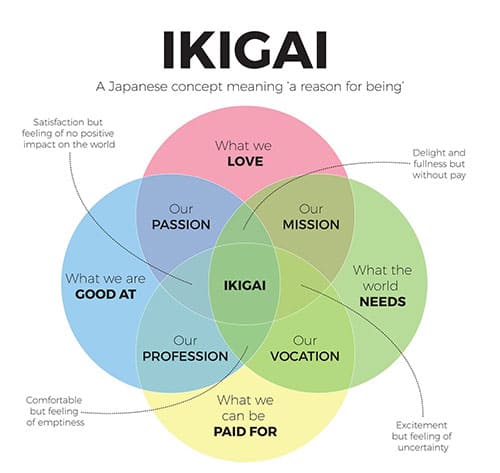
Have you found your ikigai?

despina · Feb 9, 2021 ·

As we head into February and enthusiasm for those well-intentioned New Year’s resolutions begins to wane, maybe now is the perfect time to plan out what you are really wanting to achieve.

It’s easy to fall into the New Year’s resolution trap. January 1 rolls around and resolutions for the year ahead are often hastily made without consideration of the bigger plan for your life. It’s therefore not unusual to limp into February with a string of broken resolutions and no clear idea of why they were so important just a month ago.  Maybe we need something more than a date on the calendar to help us reassess our goals and dreams?  Let us introduce you to “ikigai”, the Japanese ideology that, when translated, means “a reason for being”.

What is ikigai?

A combination of the Japanese words “iki” or life, and “gai”, used to describe value or worth, this word refers to having a direction or purpose in life – or more simply, your ikigai is what gets you out of bed every morning and it’s what makes your life worthwhile.

In practice, the ikigai concept is based on finding the sweet spot where 4 fundamental values overlap, as per the diagram below.

Your ikigai is the place in the very middle, where you find a balance between all the aspects surrounding it.  If you’re retired, you may not have to worry about what you can be paid for, so you can delete that one and focus on the remaining three.

Tokyo-based neuroscientist, writer, and broadcaster Ken Mogi writes in his 2017 book, The Little Book of Ikigai: The Essential Japanese Way to Finding Your Purpose in Life, that it doesn’t matter whether “you are a cleaner of the famous Shinkansen bullet train, the mother of a newborn child, or a Michelin-starred sushi chef’; if you can find pleasure and satisfaction in what you do and you’re good at it — congratulations, you have found your ikigai.”

Finding your ikigai

Depending on how far you want to dive into this, a quick Google search will bring up a myriad of tips and worksheets to help you find your ikigai.  Hector Garcia, a writer who has released a number of books on this theory, including Ikigai: The Secret to a Long and Happy Life also makes several suggestions:-

Start by putting together a note of the top 10 things you have spent your time on this week. After writing them down, ask yourself if those things are adding purpose to your life. You can subdivide by asking yourself four questions:

  • Is it something that I love doing?
  • Is it something the world needs?
  • Is it something I’m good at?
  • Is it something I can get paid for? If it’s not something you can get paid for, is what you can get paid for a good trade-off for really financially supporting your ikigai?

If this all feels a little too regimented for you, perhaps simply use each of the 4 qualities as a prompt to think about what is and isn’t working in your life and where you might like to be directing your energy and time.  If you have figured out your ikigai,  don’t be afraid to share your ikigai with Jason Cook, your Financial Adviser – it will no doubt open up some very productive conversations about your goals, your circumstances and what direction you would really like to be heading in.


Economic Update – February 2021

despina · Feb 9, 2021 ·

A new dawn for the American economy
  • January 6 riots in Washington DC highlight the magnitude of the political divide in the US
  • Problems with vaccine roll-outs, shortages of supply and slower than forecast inoculation rates
  • China’s economy undoubtedly strong, rest of the world coming good but slower than expected

The Big Picture
Whenever a new President of the United States is sworn in, there is a natural period of reflection on the policies that were promised, and a contrast with those that went before.

One expects even more introspection when there is a change in the governing party – as there was from Republican to Democratic on 20th January 2021. In addition, this inauguration focussed attention on the end of possibly the most divisive presidency in recent history.

It would be easy to be dismissive of Trump’s term – as many Democrats have been – though, even in losing the election, Trump garnered around 48% of the popular vote. A lot of people liked him and his policies! The Sydney Morning Herald reported a statistic at the end of January that one third of Americans still thought Trump had won!

If we turn the clock back by about four and a half years – to the referendum on Britain’s membership of the European Union (EU) – the two sides to that argument were also vociferous in putting their cases. The disbelief of the losing side-rallied people to predict disarray and worse. Some even demanded a fresh referendum (and so on until they won, we suspect).

As it turns out, Brexit at the end of 2020 went quite smoothly with Britain getting most of what it wanted. The finance industry has not migrated to Europe as many predicted. It seems to be a fact of our times – either through education and/or the internet – that people on both sides of most arguments are having their voices aired and magnified like never before.

President Biden had denounced Trump’s “Make America Great Again” slogan. Trump wanted to take on each nation separately in an attempt to get good deals for the US. Biden wants to go back to multilateral agreements. On day one, Biden signed executive orders to go back into the World Health Organisation (WHO) and the Paris Climate Accord.

As with many policies, there is no universally-best outcome; just one which suits the current mood and opinions of the people it represents. The riots in Washington, DC on January 6th 2021 made it clear that not everyone is happy with the new future under Biden. Trump was impeached in the House of Representatives for his role in those riots and Biden must handle the ‘trial’ in the Senate, along with all of his other pressing issues.

Thankfully, there has not been any recurrence of the violence from when the Capitol building was over-run. Biden has a big job on his hands to make both sides see reason. The solution seems a bit like holding a big dumbbell above one’s head but grasping the bar only in the middle. Every slight movement can generate a big, potentially dangerous, sway from one side to the other.

It is also important at this time to reflect on the new sizes of the majorities in both houses of Congress. Democrats have only a slim majority in the House of Representatives – but all Democrats are not ‘equal’ and neither are all Republicans. Deal-making will still have to be done within and across parties at a frenetic pace for Biden to get close to what he wants, particularly in his first 100 days.

The balance of power in the Senate is even more precarious. The Vice President, Kamala Harris, has the casting vote but the Senate works largely on a committee structure. Will each committee have to have a 50:50 balance? And then there is the filibuster rule that doesn’t seem to be going away. That rule requires a 60:40 majority vote to avoid them. In other words, bipartisan bills will still need to be crafted.

Nevertheless, Biden has moved swiftly to sign many executive orders. These orders require no vote but the bigger bills need to go to Congress. Biden has already ended building of ‘the wall’ and mandated the wearing of masks on Federal premises and certain air travel. He has provided some relief to those whose jobs were affected by the pandemic.

On another contentious issue, Biden has shut down work on the Keystone XL oil pipeline from Alberta, Canada to a US pipeline 1,200 miles south. There are obviously economic consequences for the shut down. The upside is the reduction in the environmental and indigenous population concerns. Most things come at a price.

When we turn to the bills which must be voted on in Congress, perhaps the most important, immediate issue is the $1.9 trn proposed coronavirus relief package. Much has been made of the wish to add $1,400 to the $600 cash payments to individuals that has already just been passed in the $900 billion relief package passed in December.

Some ‘progressives’ want this $2,000 payment to lower income earning individuals to become a recurrent benefit. Others will no doubt want to scale it back, even within the Democratic party. A CNBC TV guest estimated that the package might be scaled back to about $1 trn before it can be passed.

Naturally, the new administration has already claimed that the coronavirus situation is a lot worse than they had expected. It is not clear to what problems they are referring that were not in the news in recent weeks. But doesn’t every new government everywhere try to heap as much responsibility as possible on the previous government?

Biden stated, “It’s going to get worse before it gets better”. US COVID deaths are expected to reach 500,000 in February and he said, “deaths are expected to exceed 600,000 before we start to turn the corner”.

There have been important disruptions to the supply and distribution of vaccines in the US. Biden has stated they plan to oversee 100 million vaccinations in his first 100 days. Since two doses are required for each person (although the Financial Times reports some early results from Israel suggesting that the Pfizer vaccine is 90% effective with only one dose), that means only 50 million of the 323 million Americans can be expected to be vaccinated by the end of April – at best. Apparently, herd immunity can be achieved with around 70% to 80% of the community so vaccinated. That still leaves a long way to go but it’s a great start.

There are many unknowns in these vaccine roll-outs. Does the vaccine work as well with the new strains of the virus? Moderna has stated their vaccine is much less effective with some new strains but that they are developing a new ‘booster’ vaccine. Germany is reported to not giving the AstraZeneca vaccine to over 65s because it does not work well enough – but the EU approved it anyway!

Provisional results for Novavax suggest it is 89% effective against the original strain and 85% effective against the UK variant. It is reported to be much less effective against the South Africa variant.

Can immunised people still pass on the virus? For how long does immunisation last? None of these issues, and more, should stop us supporting the initiatives. What we wonder is when will the US and global economy be relatively safe from the effects of the virus?

Much of US economic activity depends on international travel and trade. Unless all other relevant nations’ populations are largely vaccinated, normality cannot return in full. The latest growth figures for the US shows that the stellar result for quarter 3 (Q3) has pulled back to 1% for the Q4 quarter – not bad in itself but GDP for 2020 is still  3.5% below 2019’s figure.

Both the US and Europe are very much engaged in tackling the virus. Poorer countries are at the back of the queue in being allocated sufficient vaccines to produce herd immunity. Even Australia – certainly not a poor country – is facing supply constraints; and now, the EU is placing export restrictions on exports if home demand is not supplied.

Our government pre-ordered some Pfizer and a lot of AstraZeneca, but no Moderna vaccine. It turns out the AstraZeneca vaccine is insufficiently effective to produce herd immunity and we cannot access any more of the Pfizer or Moderna drugs this year – at least.

Our government’s plan is to use the AstraZeneca vaccine, manufactured by CSL in Melbourne, as a stop-gap until better vaccines become available next year. New vaccines are expected from the US, India, China and Russia. We are not yet aware of their final trial results or their availability.

We surmise that the end is potentially in sight as, according to Johns Hopkins university COVID-19 tracking, the reported daily infection rate has been falling for the last month. But we still have a long way to go and there may be fresh outbreaks and shutdowns along the way. We feel that stock markets have priced in a best-case scenario so we would not be surprised to see more market volatility until it is clear that we are indeed defeating the virus and the world can focus beyond it.

Meanwhile the Chinese economy is going from strength to strength. China surprised on the upside with its economic growth figure of 6.5% in quarter 4, 2020 compared to its 6.3% expectation. Its industrial output and fixed asset investment both beat expectations but retail sales missed at 4.6% compared to an expected 5.5%. Exports grew a stellar 18.1% against an expected 15.1%.

China slapped sanctions on 28 people from the Trump administration. Its air force has also recently conducted 20 flights in Taiwan airspace over one weekend in what has been described in some media outlets as a direct challenge to Biden. It is yet to be seen if Biden can smooth things out but there has been no sign yet of him intending to repeal the massive Trump initiated tariffs placed on Chinese imports to the US. If they were as bad as many suggested, why not repeal Trump’s executive orders?

At home, there are still many unresolved issues in the China-Australia trade war. China has held up, or imposed significant tariffs on, a variety of imports from Australia such as coal, wine, barley, copper and timber. It is not clear what China’s end-game is but iron ore prices increased rapidly through 2020 and there seems no end in sight for China’s demand of that ore. Is China trying to craft a strategy to impact iron ore prices?

Our labour market data continued to improve but the consequences of changes in COVID-affected immigration pressures may not have yet fully worked themselves into our economy.

We feel that it is time to set an investment strategy that is looking through to 2022 and beyond – and be prepared to ride out any short-term volatility in the early part of this year.

We see Biden as being too tied up with impeachment proceedings, senate committee structures, coronavirus issues and healing the rift between the two extremes of the political divide in his first 100 days to even think about tax and other policies. He campaigned on raising taxes (income, corporate and capital gains) and no doubt he will eventually make some moves in that direction. In spite of all of the fiscal stimulus packages, he will have to move slowly so as not to rock the boat too much.

We also see Australia continuing to pursue stimulus top-ups as needed. So, as far as we are concerned, there is likely to be a big push of stimulus-induced growth here and in the US. As a result of fiscal stimulus and the Federal Reserve’s quantitative easing programme, we see continued weakness in the US dollar. Providing commodity prices hold, it is possible that the Australian dollar against the US dollar will strengthen. But, again, we emphasise possible stumbles in markets if the re-opening of economies is adversely affected by new COVID outbreaks.

The consensus 2021 forecast for the S&P 500 is for a capital gain of about 10.5% and for the ASX 200 the forecast is 9% but, of course, our dividend yield is usually about 2% points higher than in the US – and many of us also benefit from franking credits. Our in-house forecasts are slightly more optimistic than the consensus but we are not expecting markets to move in a straight line. There is little hope for interest rate increases in 2021; and in an uncharacteristically forthright announcement, the Reserve Bank of Australia, following its meeting on February 2, committed to holding cash rates and terms out to 3 years at record lows of circa 0.10% out to 2024; and increased their bond-buying program by $100 billion. These are appropriate but extremely accommodative policy settings designed to support the Australian economy through COVID-19.

Asset Classes

Australian Equities 
The ASX 200 had a flat month in January but the Consumer Discretionary, Financials and Telcos sectors had strong gains. We have noted that the consensus forecast for capital gains is 9% (plus dividends and franking credits). While we have no material issue with the consensus forecast, we are concerned that the market is vulnerable, given its lofty valuations, to unexpected bad news most likely resulting from COVID-19 related events.
International Equities

The S&P 500 gained strongly in January until the last three trading days when it gave away those gains – and then some. It would seem that some disappointing news on vaccines, retail traders taking on short-sellers and the Federal Reserve’s comments about headwinds were the main contributors to the retracement.
We expect the S&P 500 also to have a relatively good year – as does the consensus forecast of 10.5%, though the current high valuations present a risk. While accurate valuation of stocks is difficult at the best of times and markets are expensive now when assessed against historical multiples, in an environment of historically low interest rates higher multiples can be accommodated. Our assessment is that providing interest rates stay low and Governments maintain stimulatory policy settings the current regime could persist for some time. In this environment we remain vigilant but we are fully invested.

Bonds and Interest Rates
It is generally accepted that central banks have done just about all they can to stimulate the global economy. They still need to continue quantitative easing – or the process of buying and selling bonds and other assets to manipulate interest rates. Official rates, being zero or close to it, are unlikely to be cut further. It is all down to elected governments using fiscal policies, as appropriate, to stimulate their respective national economies.

Bond rates are very low by historical standards and they are likely to stay there. Denmark recently announced a 0% interest rate 20-year home loan! Given the fees and break costs in term deposits, together with inflation, this creates a challenging environment for term deposit and bond investors as returns are the lowest in living memory.

Unsurprisingly, in Australia under the current regime there has been an increasing demand for equities exposure to support income return via dividend payments. With the inclusion of franking credits, gross yield is at circa 4.0% – a very big difference to that available in traditional fixed interest investments. However over longer periods, such as 5 or 10 years, Australian equities have always done well – or not too badly. It’s a question of having sufficient cash or bonds to ride out the dips in order to avail oneself of the higher yields in equities – but, of course, with an appropriately diversified portfolio.

Other Assets
Bitcoin and other crypto-currencies have been in the news again. New highs were reached recently and some hopes were dashed. The story of one particular ‘investor’ accidentally throwing out his hard drive to the tip – only to then offer the council $50 million to dig it up (because it contained his Bitcoin ‘wallet’) tells it all. There was another story of an ‘investor’ having failed on his first eight of ten password attempts facing the prospect of losing the lot if his next two guesses also fail! There was also the Mt Gox exchange hack that cost investors dearly.

Obviously, profits can be made in any asset class such as art, vintage cars and the like. Though, for normal risk-averse investors, stocks, property, bonds and cash define the bulk of the universe for prudent capital allocation.

More traditional ‘other assets’ like iron ore, copper and gold had a flat to weak month but the price of oil rose by around 8%. Volatility on Wall Street was well down until it spiked during the end-of-month sell-off. Our dollar against the US dollar was stable over January.

Regional Review

Australia
Australia’s economy always has a ‘sleepy month’ in January. 2021 was no exception. The only important data to be released maintained the view that our labour market is doing quite well given the existence of the pandemic. The unemployment rate is down to 6.6% after peaking at 7.5% in July 2020. This rate was 5.1% in December 2019. The government is predicting that it will take four years for unemployment to get back to pre-COVID rates.

There were big concerns about fresh breakouts in COVID-19 following Christmas and New Year celebrations. There are restrictions of various types across the country but it seems there is a will to get back to normal quickly.

Australia is much better off than the US or UK in handling the virus. We ranked eighth in a study of 100 countries in how well we have dealt with, and are dealing with, the virus. New Zealand came first.

Arguably, our biggest problem is that we backed the wrong horse in the vaccination stakes. The Oxford University/AstraZeneca vaccine turned out to be an underperformer as we reported in these updates last year. Its ‘efficacy’, or the ability to immunise people from the virus is too low to prevent herd immunity. Herd immunity is the concept that the proportion of people in the community that are immune is so high as to make transmission rates to others to be very low and eventually fizzle out.

Our government tried to get more of the superior Pfizer and Moderna vaccines but that event is ‘sold out’. We will have to use a less-than-premium vaccine until we can secure supplies of something as good as the US is rolling out.

There is no question of safety. It is just that efficacy rates are about 60% compared to the 95% of the “mRNA” vaccines produced by Pfizer and Moderna. Unfortunately, it is a ‘watch this space’ for news on how we will cope with the medical side of the pandemic.

Naturally, our economy cannot get back to anything like normal while we are not safe from the virus. Between now and then we expect short periods of lockdowns and disruptions that will slow down economic growth. The same is true for other countries but we have a less than optimal vaccine solution which is likely to see greater focus on social measures such has lockdowns, social distancing etc.

China
China is angling for a new relationship with the US after the end of the ‘hard-ball’ Trump administration. They certainly have focused their ire on Australia for the last few months so it is a question of whether Biden marches arm-in-arm with Australia down Pennsylvania Avenue or whether he throws us under the bus.
We are yet to see where Australia-US relations will head. On our own, we may have problems dealing with China’s wrath on Australia because of our prior allegiances to the US and our comments on China’s role in starting the pandemic.

On the bright side, China’s economic data has looked pretty good. First in – first out of the pandemic has put China in good stead. Their economic growth just came in at 6.5% p.a. which would have been seen as a positive pre-COVID.

Exports recorded a growth of 18.1% against an expected 15% while imports came in at 6.5% against a 5% expectation.

US
The US economy is going through a massive transition as its economy deals with the consequences of COVID-19. Jobs and other economic data are worse than pre-COVID days but much better than at the height of the February 2020 to July 2020 part of the crisis.

The latest nonfarm payrolls data recorded a loss of 140,000 jobs when +50,000 new jobs were expected. The unemployment rate was 6.7% against an expected 6.8%.

Q4 GDP growth came in at 4% (annualised) or 1% quarter-on-quarter. Since the economy is still rebounding from the Q2 low, 1% is not great however, in an ordinary year it would have been. That growth in GDP in 2020 over 2019 was  3.5%, a lot more growth is needed to get back to previous highs.

The Case-Shiller house price index across 20 cities was up 9.5% over the 12 months to November – which is near record highs.

The big thing that we don’t know is how Americans will react to new rules and regulations over COVID. First amendment rights seemingly reign supreme in the US. Will they wear masks – especially after some have the comfort of having been vaccinated? Americans are very different people from Australians, British and Europeans.

We see that there is a clear light at the end of the tunnel. But it will not be an easy road to get there. Biden has promised much and hopefully he will achieve. But, what if he doesn’t? It is a country politically divided by so much.

Europe
A month after Brexit, there still seem to be no major fall outs after the exit. Of course, Britain is in a bit of a mess over their handling of COVID-19 but that has nothing to do with Europe and the Brexit negotiations.

The EU and UK economies are not doing well. But, in the short-term, it is more of what governments are prepared to borrow to stimulate economies rather than what economies can do for themselves.

Given that the EU is now restricting exports of vaccines if they need it first, there seems little chance that Australia will get its fair share – or even what it ordered – this year.

Rest of the World 
While all of the vaccine roll-outs get underway, little seems to be written about when the rest-of-the-world can access the vaccine. One SBS News report did mention a full global roll-out might take until well into 2024. Israel and certain Arab Gulf states are well ahead in vaccinations. Israel has already vaccinated over 25% of its population.

Until all nations that interact with the developed world are largely vaccinated, there can be no complete herd immunity; and that brings us to: who will pay for those vaccinations?

21 Trends to Watch in 2021

despina · Jan 15, 2021 ·

1. Data analytics tools are beginning to measure and even predict how effective a virtual meeting is READ MORE
2. Meat-free meat is set to become mainstream with new regulatory approvals granted READ MORE
3. Augmented reality technology is showing great promise in recreating the in-store experience while grocery shopping from home READ MORE
4. Geothermal energy set to finally move to the foreground of the renewable power discussion READ MORE
5. Amazon’s plan to enter the prescription drug business is it’s next big step toward world domination READ MORE
6. Law enforcement officials announce plans to start monitoring the smart doorbell footage of private homes to improve security – but at what cost? READ MORE
7. Netflix announces plans to launch a programmed linear content channel much like the ones it disrupted with the move to on-demand streaming READ MORE
8. Smart glass technology will soon allow windows in buildings to change colour and become solar-producing surfaces on hot days READ MORE
9. Microscopic robots that can be injected into the body to deliver targeted therapies are about to become a reality READ MORE
10. The marketing ‘holy grail’ of social commerce is set to ramp up with a partnership between Spotify and TikTok READ MORE
11. New construction technology uses recycled plastic to create durable and effective building materials READ MORE
12. Employers are increasingly using technology that monitors employee’s screens to ensure the productivity of their remote workforce READ MORE
13. Recruitment is set to get high tech with job interviews and application screening to be done increasingly by AI-powered robots READ MORE
14. ‘Liquid biopsy’ blood tests that can detect up to 50 cancers before any symptoms emerge are set to be rolled out READ MORE
15. In an age of contact-free commerce, holographic menu screens for meal ordering look set for wide-scale adoption READ MORE
16. After years of experimentation and research, drone delivery services have finally received government approval and are preparing for launch READ MORE
17. Self-driving cars have become one step closer to reality with new laws in the UK permitting ‘hands-free’ driving READ MORE
18. Recently drafted legislation in Germany has enshrined working from home as a legal right – paving the way to similar laws elsewhere READ MORE
19. In the aftermath of lockdowns, under-utilised CBD parking garages are being converted into community gardens and public spaces READ MORE
20. New weed-killing robots could spell the end of widespread pesticide use in farming and agriculture READ MORE
21. Virtual and augmented reality technology is set to transform remote delivery of everything from engineering support to healthcare READ MORE

Source: Michael McQueen December Newsletter 2020

5 New Year’s resolutions for your finances

despina · Jan 15, 2021 ·

The New Year is the perfect time to take a fresh look at your finances.

  1. Start tracking your spending

It doesn’t sound like fun, but if you don’t know where your money goes, it’s impossible to understand your spending patterns and identify habits that are making it harder to achieve your financial goals. With the ability to simply “tap” it often feels like we aren’t parting with our money and we can quickly lose our sense of just how much we are spending and on what.  To get started, try the Australian Government’s MoneySmart budget planner – you might just be amazed at where your money goes!

  1. Do a subscription audit

Do a review of all your subscriptions – whether it be TV, music, shopping, fitness, food delivery services and more, these subscriptions can creep up on us very quickly.  Do a quick check to make sure you are still using all your subscriptions and that they continue to represent good value.

  1. Sort your super strategy

Whether you have your super in multiple places, don’t know where your super is, don’t have super at all yet, or you accessed your super during COVID, it’s time to work out your plan going forward. Super is “super important” and it’s vital that you ensure that you are making the most of your super contribution and not having your balance eaten away by fees.  Make an appointment with Jason Cook, Financial Adviser, to review your super situation and work out an effective strategy for the future.

  1. Review your home loan

2020 saw interest rates drop to a record low, so if you have a home loan and haven’t already done so, make sure you speak to your loan provider about a more competitive interest rate.  And if you have no success there, Ed and the team at the Infocus Lending Advisory will be more than happy to assist you. 

  1. Do a provider review

Are you still getting the best deal from your electricity provider? Or your health insurer or car insurer?  It’s easy to fall into the habit of simply paying our renewals and bills without ever asking the question of whether there is something more these providers can do for us.  For the sake of a few minutes for each provider, it’s certainly worth asking the question!

We are all about helping you achieve your financial goals; so, if you have any questions, please don’t hesitate to contact us.

  • « Go to Previous Page
  • Page 1
  • Interim pages omitted …
  • Page 15
  • Page 16
  • Page 17
  • Page 18
  • Page 19
  • Go to Next Page »
  • Disclosure information
  • Partners

Presidio Financial Services Pty Ltd, trading as WB Financial Australia
ABN 67 118 833 168
Corporate Authorised Representative No. 312532
Level 1, 32 Logan Road
Woolloongabba, QLD, 4102

PO Box 8259
Woolloongabba, QLD, 4102

Infocus Securities Australia Pty Ltd
ABN 47 097 797 049
AFSL 236523
Level 2, Cnr Maroochydore Road & Evans St
Maroochydore, QLD, 4558

The material on this website has been prepared for general information purposes only and not as specific advice to any particular person. Any advice contained on this website is General Advice and does not take into account any person's particular investment objectives, financial situation and particular needs. Before making an investment decision based on this advice you should consider, with or without the assistance of a securities adviser, whether it is appropriate to your particular investment needs, objectives and financial circumstances. In addition, the examples provided on this website are provided for illustrative purposes only. Although every effort has been made to verify the accuracy of the information contained on this website, Infocus, its officers, representatives, employees and agents disclaim all liability (except for any liability which by law cannot be excluded), for any error, inaccuracy in, or omission from the information contained in this website or any loss or damage suffered by any person directly or indirectly through relying on this information.

This website uses cookies to improve your experience. We'll assume you're ok with this, but you can opt-out if you wish. Cookie settingsAccept
Privacy & Cookies Policy

Privacy Overview

This website uses cookies to improve your experience while you navigate through the website. Out of these cookies, the cookies that are categorized as necessary are stored on your browser as they are as essential for the working of basic functionalities of the website. We also use third-party cookies that help us analyze and understand how you use this website. These cookies will be stored in your browser only with your consent. You also have the option to opt-out of these cookies. But opting out of some of these cookies may have an effect on your browsing experience.
Necessary
Always Enabled
Necessary cookies are absolutely essential for the website to function properly. This category only includes cookies that ensures basic functionalities and security features of the website. These cookies do not store any personal information.
SAVE & ACCEPT